Cassava and cassava products: Market unsustainable consumption
Cassava and cassava products: Market unsustainable consumption
Cassava was introduced to Vietnam in the mid 18th century and is grown throughout the territory of our country due to the ability to adapt well to the climate and soil. Previously, cassava is considered a staple food for a great number of farmers in Vietnam. But now thanks to the strong development of science and technology, cassava role being converted from food crops, food crops into commodities ...
CongThuong - cassava exports ranked second in the world, but the market insecurity
Exports of cassava and cassava products in Vietnam is ranked second in the world, just behind Thailand and has presence in countries in Asia such as China, South Korea, Malaysia, Indonesia, India, Myanmar, Japan ... With "victories", the cassava and cassava products has become a major export commodities, the group joined the commodity exports over U.S. $ 1 billion / year. However, output and exports these products are decreasing. For example, in 2012, the volume of cassava and cassava products exports reached record levels with more than 4.2 million tons of cassava product types worth U.S. $ 1.35 billion, an increase of over 57% in volume and nearly 41% in value compared to 2011., but in 2013 the export of cassava and cassava products reached 3.1 million tons, with a turnover of 1.1 billion U.S. dollars, down 25.7% in volume and decreased by 18.6% in value compared with 2012. 2014, the volume of exports in the first 2 months of this year reached 652 thousand tons with a value of 206 million U.S. dollars, down 32.7% in volume and 30.6% in value compared to the same period in 2013.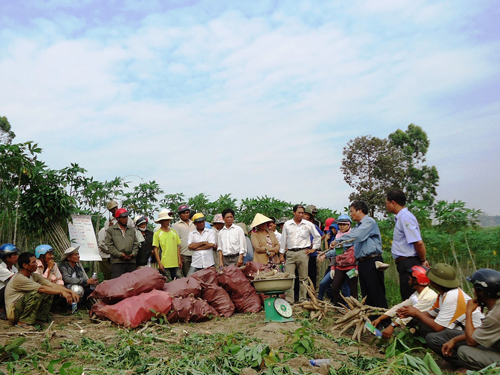
According to the Vietnam Association of Cassava, cassava growing area of the country is 560 thousand hectares, with a total production of nearly 9.4 million tons. Of these, 30% yield obtained serve domestic demand for food, feed and processing, pharmaceutical industry, as raw materials biofuel production, industrial alcohol, while 70% are exported in the form of starch or cassava.
But Vietnam cassava exports ranked second in the world, but at present, China's import market products of Vietnam's largest cassava (accounting for 85.6%). However, in 2013 our country's cassava exports to China market decreased 19.8% compared to 2012, due to the ethanol plant here has closed nearly 70%, a reduced number of remaining capacity demand for imports plunged. One thing worth noting is that, the price of cassava exports from Vietnam to the Chinese market in particular and the world in general the market is reduced, as supplies from other export markets (such as Thailand and Indonesia) is very large.
It should not be beyond the planning cassava
Urgent requirement now is to actively market and especially the main priorities of the local market demand for processed animal feed and other needs, especially biofuels production (biological energy).
Although cassava is regarded as one of the important raw materials for processing animal feed, but for many years, the factory feed our country is always in a state of "hunger" this material, by a simple reason: Cassava has traders buying for export. Supply shortage, rising domestic prices, many businesses are forced to switch to using alternative materials, most of which is imported as: corn, rice bran, soybean and wheat prices expensive ... red. This is one of the reasons food prices rising domestic livestock, the livestock industry has always been making losses.
Regarding biological energy production needs yet also positive. As of 2013, Vietnam has 7 manufacturing plants use biological energy is raw cassava. However, because the use has not been opened, so now only the Dung Quat ethanol plant with a capacity operation 50 - 60%. The remaining ethanol plants produced only in moderation, even to "slide up".
The Prime Minister's decision: 7 provinces and cities: Hanoi, Ho Chi Minh City, Da Nang, Hai Phong, Can Tho, Quang Ngai and Ba Ria - Vung Tau mandatory E5 bio gasoline use from 1/12 / 2014 dated 12.01.2015 and to be used across the country, will open up opportunities for cassava consumption in the domestic market. However, experts have noted, the ministries, branches and functions of local government should direct the interested farmers maintained only in the planning area, not for massive deforestation relative cassava , causing damage to the poor, especially ethnic minorities.
Than Thuy Ha


