Tapioca leaves
Tapioca is a starch found in the roots (tubers) of the plant. Different parts of the plant such as the root, leaves, and sometimes the whole plant, are used in herbal remedies.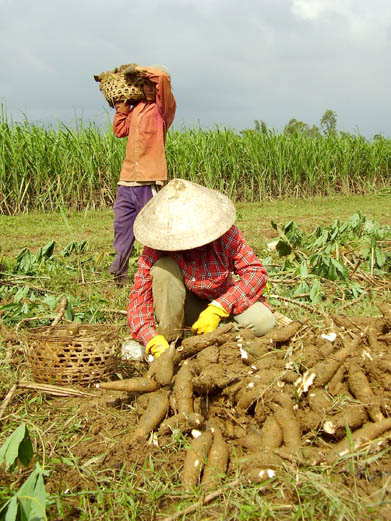
Cassava has been used as a food source by many cultures for centuries. Today, it is consumed by millions of people in developing countries and is sometimes used as an herbal medicine. It has been theorized that the plant's ability to make cyanide may be useful as a type of gene therapy to treat cancer, but further research is needed to determine whether the technique will work in humans. This use would be quite different from the use of the cassava plant as an herbal remedy.
Although initially the cassava plant, was native to South America, today farms grow this shrub throughout the world, particularly in Africa. Different sections of cassava work as food sources for humans and livestock, and can also be made into commercial products, such as glue or rubber. To cook a cassava leaf you must boil it. In raw form, the leaf is toxic. When you boil the leaves the poison is neutralized and the cassava is safe to eat.
The cassava plant is a staple crop in Africa, Asia, and South America. Tapioca is a starch found in the roots (tubers) of the plant. Different parts of the plant such as the root, leaves, and sometimes the whole plant, are used in herbal remedies.
Cassava leaf has three main uses.
Primarily, it is used as a sauce and is usually eaten with rice. Such usage has spread to other countries in West Africa.
Secondly, it is used as feed for cattle, goats and sheep. The animals either eat the leaves off the live plant or the leaves are fed to them after harvest.
Finally, the leaves have medicinal values when ground int a paste.


